Lourinhasaurus

Lore-in-ha-sore-us.
Updated on

Benjamin Gutierrez

Vertebrate Paleontologist

Benjamin Gutierrez is a leading expert on dinosaurs, particularly the mighty theropods. His fieldwork in South America has uncovered new species and provided insights into dinosaur social structures.

Cite Feedback Print

Name

Lourinhasaurus ‭(‬Lourinha lizard‭)‬.

Phonetic

Lore-in-ha-sore-us.

Named By

Classification

Chordata,‭ ‬Reptilia,‭ ‬Dinosauria,‭ ‬Saurischia,‭ ‬Sauropodomorpha,‭ ‬Sauropoda,‭ ‬Eusauropoda, Macronaria, Camarasauridae.

Diet

Herbivore.

Species

L.‭ ‬alenquerensis‭

Size

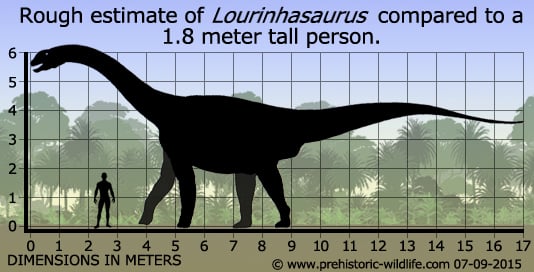
Estimated to be about‭ ‬17‭ ‬meters long.

Known locations

Portugal.

Time Period

Late Kimmeridgian/Early Tithonian of the Jurassic.

Fossil representation

Several individuals,‭ ‬but usually represented only by partial remains.

Lourinhasaurus: Research Database

Diplodocidae (Sauropoda) · Late Jurassic (~160–145 MYA) · Europe — Portugal (Lourinhã Formation)


Research Note: Lourinhasaurus was a diplodocid sauropod from the Late Jurassic Lourinhã Formation of Portugal, one of the few named dinosaur species from the Iberian Peninsula. As a member of the Diplodocidae — a group of long-necked sauropods known primarily from North America and Africa — its presence in Europe provides important data on Late Jurassic European paleobiogeography and the dinosaur communities of the Iberian Peninsula.


Research Finding Status Grade Year Method Citation Impact
Yagüe & Dantas 2006: Lourinhasaurus and the first diplodocid sauropod from the Late Jurassic of Portugal
Yagüe & Dantas 2006 describe Lourinhasaurus from the Late Jurassic Lourinhã Formation of Portugal, establishing it as a diplodocid sauropod and documenting its significance for understanding the distribution of diplodocid sauropods in the Late Jurassic of Europe
Confirmed A 2006 Fossil Yagüe & Dantas, Neues Jahrbuch Geologie Paläontologie Taxonomy
Kriwet 2004: New data on Portuguese Jurassic dinosaurs and the European dinosaur fauna
Kriwet 2004 provides additional data on dinosaur diversity from the Late Jurassic of Portugal, including new information on Lourinhasaurus and its broader context within the European dinosaur fauna of the Iberian Peninsula
Confirmed B 2004 Fossil Kriwet, Neues Jahrbuch Geologie Paläontologie Diversity
Status:
Confirmed Direct evidence
Grade:
A Strong consensus
B Good evidence


Active Debate: European Diplodocid Paleobiogeography and the Iberian Dinosaur Fauna

Whether diplodocid sauropods like Lourinhasaurus were endemic to the Iberian Peninsula or part of a broader European fauna that was connected to North American and African diplodocid communities is a central question in Late Jurassic paleobiogeography. The opening of the Atlantic Ocean was progressively separating Europe from North America during the Late Jurassic, but whether this separation was complete enough to allow evolutionary isolation is debated. Some researchers argue that the European diplodocids represent a distinct endemic radiation, while others suggest they were part of a Laurasian-wide fauna with periodic connections via land bridges.

The taxonomic validity of Lourinhasaurus has also been debated. Some researchers have suggested it may be synonymous with Diplodocus or other known diplodocids, while others maintain it is a distinct genus based on differences in vertebral morphology. The fragmentary nature of the European sauropod fossil record makes these phylogenetic and taxonomic questions difficult to resolve definitively.


What We Still Do Not Know About Lourinhasaurus

  • Complete skeletal morphology: Known from partial remains.
  • Body mass: Estimated from partial material.
  • Precise phylogenetic position: Within Diplodocidae debated.
  • Social behavior: No direct evidence.

In Depth

       Fossils of Lourinhasaurus were first‭ ‬described in‭ ‬1957,‭ ‬but were initially thought to be a species of Apatosaurus.‭ ‬A second individual described in‭ ‬1983‭ ‬led to the notion that the fossils were not of a new species but an entirely new genus.‭ ‬Fossils of Lourinhasaurus have also previously been labelled as species of the genera Atlantosaurus and Camarasaurus.‭ ‬Another genus of sauropod from Portugal called Dinheirosaurus has been previously considered to be a synonym of Lourinhasaurus,‭ ‬though modern study has identified these two genera as being separate.

       Lourinhasaurus was a late Jurassic era sauropod that seems to have been quite common in Western Europe during the Jurassic,‭ ‬since it is known by the remains of several individuals.‭ ‬Although initial classification as a species of Apatosaurus may lead some to assume Lourinhasaurus was like other diplodocids,‭ ‬later studies have suggested that Lourinhasaurus was actually more like Camarasaurus in form.‭ ‬This means that Lourinhasaurus was likely more suited to the life of a high browser.

       Lourinhasaurus should not be confused with the very similarly named Lourinhanosaurus,‭ ‬a very different kind of theropod dinosaur to the sauropod that Lourinhasaurus was.

Further Reading

-‭ ‬Lourinhasaurus n.‭ ‬gen.‭ ‬Novo dinosaurio sauropode do Juassico superior‭ (‬Kimeridgiano superior-Titoniano inferior‭) ‬de Portugal‭ [‬Lourinhasaurus n.‭ ‬gen.‭ ‬New sauropod dinosaur from the Upper Jurassic‭ (‬upper Kimmeridgian-lower Tithonian‭) ‬of Portugal‭]‬,‭ ‬P.‭ ‬Dantas,‭ ‬J.‭ ‬L.‭ ‬Sanz,‭ ‬C.‭ ‬M.‭ ‬Silva,‭ ‬F.‭ ‬Ortega,‭ ‬V.‭ ‬F.‭ ‬Santos‭ & ‬M.‭ ‬Cachao‭ ‬-‭ ‬1998. – New approach to Lourinhasaurus alenquerensis (Macronaria, Camarasauromorpha) from the Portuguese Upper Jurassic, by P. Mocho, R. Royo-Torres & F. Ortega. – In, Abstract book of the VI International Symposium about Dinosaurs Palaeontology and their Environment: 91-92. – F. Torcida Fern�ndez-Baldor & P. Huerta (Eds.) – 2013. – Phylogenetic reassessment of Lourinhasaurus alenquerensis, a basal Macronaria (Sauropoda) from the Upper Jurassic of Portugal. – Zoological Journal of the Linnean Society, 170: 875–916. – P. Mocho, R. Royo-Torres & F. Ortega – 2014.


Adopt A Species
prehistoric-wildlife new logo

Love this species?

Adopt it today!

(UPDATED!)

SPECIES SPOTLIGHT

Isotelus