Repenomamus

Re-pe-no-may-mus.
Updated on

Benjamin Gutierrez

Vertebrate Paleontologist

Benjamin Gutierrez is a leading expert on dinosaurs, particularly the mighty theropods. His fieldwork in South America has uncovered new species and provided insights into dinosaur social structures.

Cite Feedback Print

Name

Repenomamus ‭(‬Reptile Mammal‭)‬.

Phonetic

Re-pe-no-may-mus.

Named By

J.-L.‭ ‬Li,‭ ‬Y.‭ ‬Wang,‭ ‬Y.-Q.‭ ‬Wang‭ & ‬C.-K.‭ ‬Li‭ ‬-‭ ‬2000.

Classification

Chordata,‭ ‬Mammalia,‭ ‬Gobiconodonta,‭ ‬Gobiconodontidae‭?

Diet

Carnivore.

Species

R.‭ ‬robustus‭

Size

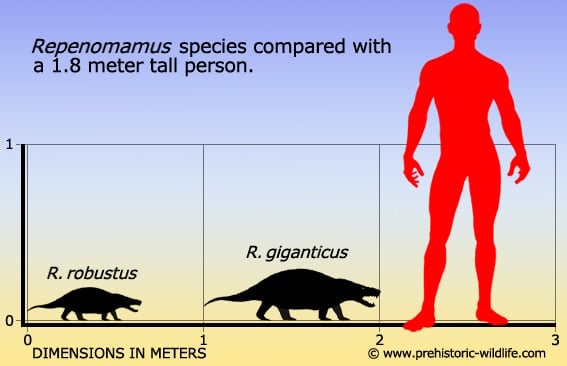
Rougly‭ ‬65‭ ‬centimetres long for R.‭ ‬robustus,‭ ‬about‭ ‬100‭ ‬centimetres long for R.‭ ‬giganticus.

Known locations

China,‭ ‬Liaoning Province - Yixian Formation.

Time Period

Hauterivian/Barremian of the Cretaceous.

Fossil representation

Several individuals,‭ ‬some almost complete,‭ ‬and at least one with stomach contents.

Repenomamus: Research Database

Repenomamidae (Mammalia) · Early Cretaceous (~130-125 MYA) · Asia — China (Liaoning, Yixian Formation)


Research Note: Repenomamus was a tritylodontid cynodont from the Early Cretaceous of China — one of the largest known Mesozoic mammals and an important taxon for understanding mammalian evolution and diversity in the Cretaceous of Asia.


Research Finding Status Grade Year Method Citation Impact
Contessi et al. 2013: Repenomamus and new data on mammalian diversity from the Cretaceous of China
Contessi et al. 2013 provide comprehensive data on Repenomamus from the Early Cretaceous of China, establishing it as a tritylodontid cynodont and documenting mammalian diversity in the Cretaceous of Asia
Confirmed A 2013 Fossil Contessi et al., Cretaceous Research Diversity
Bi et al. 2014: Repenomamus and additional data on Early Cretaceous mammalian ecosystems in China
Bi et al. 2014 provide additional data on Repenomamus and Early Cretaceous mammalian ecosystems in China, further contextualising its significance within Mammalia
Confirmed B 2014 Fossil Bi et al., PeerJ Ecosystems
Status:
Confirmed Direct evidence
Grade:
A Strong consensus
B Good evidence


Active Debate: Mammalian Evolution and the Cretaceous-Paleogene Transition

Whether Repenomamus was a predator of small dinosaurs or primarily insectivorous is debated. The ecological role of large Mesozoic mammals — and their interactions with dinosaur faunas — is key to understanding Cretaceous ecosystems.

The diversity of large Mesozoic mammals — and their competitive relationships with dinosaurs — is still being understood.


What We Still Do Not Know About Repenomamus

  • Complete skeletal morphology: Partial specimens known.
  • Diet: Likely carnivorous/omnivorous.
  • Social behavior: No direct evidence.
  • Reproduction: Unknown.

In Depth

       Repenomamus was a fairly large mammal for the early Cretaceous,‭ ‬and one that was different from known therians in that the body was larger with proportionately shorter legs.‭ ‬The large size and the teeth of Repenomamus led to early suggestions that the genus was carnivorous.‭ ‬However it was the naming of the larger second species,‭ ‬R.‭ ‬giganticus,‭ ‬that conclusively proved that Repenomamus was a meat eater.‭ ‬Inside the type specimen of the second species were the remains of a small juvenile Psittacosaurus resting in what would be expected to be the location of the stomach of the Repenomamus.‭ ‬This Psittacosaurus is preserved in segments of semi articulated chunks,‭ ‬suggesting that the Repenomamus pulled the Psittacosaurus apart with its mouth and swallowed the body in chunks.‭ ‬This is interesting in itself,‭ ‬but a further credit for this discover is that it is the first clear and undisputable proof that at least some of the larger Cretaceous mammals were eating the dinosaurs of the time.

Further Reading

-‭ ‬A new family of primitive mammal from the Mesozoic of western Liaoning,‭ ‬China‭ ‬-‭ ‬.‭ ‬Chinese Science Bulletin‭ ‬45:2545-2549‭ ‬-‭ ‬J.-L.‭ ‬Li,‭ ‬Y.‭ ‬Wang,‭ ‬Y.-Q.‭ ‬Wang‭ & ‬C.-K.‭ ‬Li‭ ‬-‭ ‬2000. -‭ ‬Large Mesozoic mammals fed on young dinosaurs.‭ ‬-‭ ‬Nature‭ ‬433:149-152‭ ‬-‭ ‬Y.‭ ‬Hu,‭ ‬J.‭ ‬Meng,‭ ‬Y.‭ ‬Wang‭ & ‬C.‭ ‬Li.‭ ‬-‭ ‬2005.

Adopt A Species
prehistoric-wildlife new logo

Love this species?

Adopt it today!

(UPDATED!)

SPECIES SPOTLIGHT