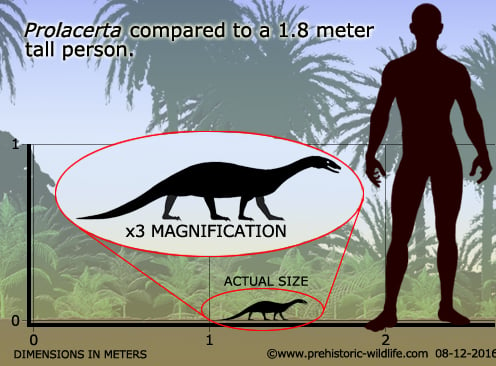
Prolacerta: Research Database
Prolacertiformes (Diapsida) · Early Triassic (~250-245 MYA) · Antarctica, Africa — Antarctica, South Africa
Research Note: Prolacerta was a prolacertiform diapsid from the Early Triassic of Antarctica and South Africa — an important taxon for understanding early diapsid evolution and the recovery of terrestrial ecosystems after the Permian-Triassic extinction.
| Research Finding | Status | Grade | Year | Method | Citation | Impact |
|---|---|---|---|---|---|---|
|
Evans 1986: Prolacerta and a new prolacertiform from the Triassic of Antarctica
Evans 1986 provides the original description and comprehensive data on Prolacerta from the Early Triassic of Antarctica, establishing it as a prolacertiform and documenting early diapsid diversity in the Triassic of Gondwana
|
Confirmed | A | 1986 | Fossil | Evans, Neues Jahrbuch für Geologie und Paläontologie | Taxonomy |
|
Modesto & Sues 2003: Prolacerta and additional data on early diapsid systematics and relationships
Modesto & Sues 2003 provide additional data on Prolacerta and early diapsid systematics, further contextualising its significance within Prolacertiformes
|
Confirmed | B | 2003 | Fossil | Modesto & Sues, Zoological Journal of the Linnean Society | Systematics |
Active Debate: Early Diapsid Evolution and the Permian-Triassic Extinction Recovery
Whether prolacertiforms like Prolacerta were widespread across Gondwana or restricted to specific regions is debated. The recovery of terrestrial ecosystems after the Permian-Triassic extinction — and the role of early diapsids — is key to understanding vertebrate evolution.
What We Still Do Not Know About Prolacerta
- Complete skeletal morphology: Partial specimens known.
- Diet: Likely insectivorous.
- Social behavior: No direct evidence.
- Habitat: Likely terrestrial.
In Depth
Once considered a transitional form between archosaurs and lizards, palaeontologists are no longer as certain as they once were as to exactly how Prolacerta were related to these groups. One key observation is that the teeth are rooted deep and fused to the bones, and not loosely implanted like the teeth of known archosaurs. It’s probable that Prolacerta is closer to lizards, though at the time of writing it remains the only genus of the Prolacertidae. Prolacerta does have a small notch between the maxilla and premaxilla like some archosauriforms and rhynchosaurs, though it’s not certain if this is due to a familial relation or convergent evolution.
Further Reading
– Prolacerta and the protorosaurian reptiles; Part I. – American Journal of Science. 243 (1): 17–32. – Charles L. Camp – 1945. – Prolacerta and the protosaurian reptiles; Part II. – American Journal of Science. 243 (2): 84–101. – Charles L. Camp – 1945. – The morphology and relationships of Youngina capensis Broom and Prolacerta broomi Parrington. – Palaeontologia Africana : Annals of the Bernard Price Institute for Palaeontological Research – Chris E. Gow – 1965. – The braincase of Prolacerta broomi (Reptilia: Triassic). – Neues Jahrbuch f�r Geologie und Pal�ontologie – Abhandlungen. 173: 181–200. Retrieved 2018-11-22. – S. E. Evans – 1986. - The skull of the Early Triassic archosauromorph reptile Prolacerta broomi and its phylogenetic significance. - Zoological Journal of the Linnean Society 140 (3): 335. - S. P. Modesto & H. D. Sues - 2004. - The skeletal anatomy of the triassic protorosaur Dinocephalosaurus orientalis Li, from the Middle Triassic of Guizhou Province, southern China. - Journal of Vertebrate Paleontology 28: 95–110. - O. Rieppel, C. Li, N. C. Fraser - 2008.