In Depth
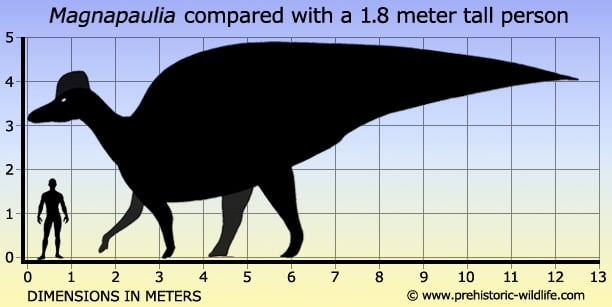
When fossils of this dinosaur were originally described as Lambeosaurus laticaudus, the estimated size of the species was given as between fifteen and sixteen and a half meters long, something that causes inaccurate size quotations for Lambeosaurus to this day even though larger individuals of this genus are around the nine meter mark. When re-described as Magnapaulia laticaudus however, the describers came up with an estimate of twelve and a half meters long. Although probably not as large as some giant hadrosaurids like Shantungosaurus from Asia, Maganpaulia remains one of the largest currently known lambeosaurine hadrosaurids from North America.
In life Maganpaulia may have spent a lot of time in the water. The high neural spines on the vertebrae, particularly those of the caudal vertebrae would have increased the surface area of the tail given it more ‘push’ if it were used for swimming. However it should be pointed out that many hadrosaurids have these high spines, including ones not directly associated with wetland environments. Another argument favouring swimming comes from a broken femur (thigh bone) in the holotype remains that managed to heal. Such an injury should have proved fatal for a land based creature, but if immersed in water, a dinosaur like Maganpaulia could feasibly have kept weight off it long enough for it to heal. however counter arguments to this could include the injury taking place during the juvenile stage when bones tend to heal more quickly because of the growth factor, to the individual in question simply resting more weight upon the other three limbs and being able to avoid predators long enough for the broken bone to heal.
The hip arrangement of Maganpaulia has also been interpreted as being weak, though how strong it would have to be would depend upon the weight of the animal. The distribution of said weight and how the dinosaur supported that weight. If more load was placed on the forelimbs for example then the hips would not need to be as strong. The final bit of evidence that supports to Maganpaulia being more aquatic is actually one of association to the related genus Lambeosaurus. Study of the fossil locations this genus is known from have indicated that it may have lived near coastlines as well as a discovery of possibly Lambeosaurus jaw bones in a marine deposit by palaeontologist Jack R. Horner.
With the above theories in mind it is certainly possible that Maganpaulia was a swimmer, even with its large physical size and possible weight, water buoyancy may have allowed it to float while swimming with its limbs, just like with elephants today. Additionally the near coastal ecosystems associated with its more closely related genera (i.e. many lambeosaurines) mean that large bodies of water such as tidal rivers, estuaries and lagoons would have likely been quite common, and being a strong swimmer could only be a benefit in such ecosystems. The only thing that cannot be ascertained for certain is how much time Maganpaulia would have spent in the water. Being able to better swim in a wet habitat does not necessarily mean that Maganpaulia spent all of its time in the water.
The lambeosaurine hadrosaurid Velafrons is thought to be particularly closely related to Magnapaulia.
Further Reading
- The lambeosaurine dinosaur Magnapaulia laticaudus from the Late Cretaceous of Baja California, Northwestern Mexico, A. Prieto-Marquez, L. M. Chiappe, S. H. Joshi - 2012, Peter Dodson ed. - A new species of hadrosaurian dinosaur from the Upper Cretaceous of Baja California: ?Lambeosaurus laticaudus, William J. Morris - 1981. - Anatomy and relationships of Lambeosaurus magnicristatus, a crested hadrosaurid dinosaur (Ornithischia) from the Dinosaur Park Formation, Alberta, David C. Evans & Robert R. Reisz - 2007. – The lambeosaurine dinosaur Magnapaulia laticaudus from the Late Cretaceous of Baja California, Northwestern Mexico. – PLoS ONE. 7 (6): e38207. – A. Prieto-M�rquez, L. M. Chiappe & S. H. Joshi – (Peter Dodson, ed.) – 2012.