Kwanasaurus

Kwa-nah-sor-us.
Updated on

Benjamin Gutierrez

Vertebrate Paleontologist

Benjamin Gutierrez is a leading expert on dinosaurs, particularly the mighty theropods. His fieldwork in South America has uncovered new species and provided insights into dinosaur social structures.

Cite Feedback Print

Name

Kwanasaurus ‭(‬Kwana lizard/alt.‭ ‬eagle lizard‭)‬.

Phonetic

Kwa-nah-sor-us.

Named By

J.‭ ‬W.‭ ‬Martz‭ & ‬B.‭ ‬J.‭ ‬Small‭ ‬-‭ ‬2019.

Classification

Chordata,‭ ‬Reptilia,‭ ‬Dinosauriformes,‭ ‬Dracohors,‭ ‬Silesauridae,‭ ‬Sulcimentisauria.

Diet

Herbivore.

Species

K.‭ ‬williamparkeri‭

Size

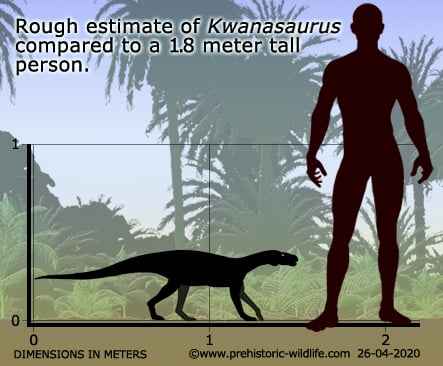
Uncertain due to lack of remains,‭ ‬but comparison to other silesaurids suggests larger individuals possibly around‭ ‬1.5‭ ‬meters long.

Known locations

USA,‭ ‬Colorado‭ ‬-‭ ‬Chinle Formation.

Time Period

Norian of the Triassic.

Fossil representation

Partial remains of several individuals,‭ ‬including partial skull and jaw bones,‭ ‬teeth,‭ ‬and fore and hind limb bones.

Kwanasaurus: Research Database

Squamata (Reptilia) · Late Cretaceous (~70 MYA) · North America — USA (Wyoming)


Research Note: Kwanasaurus was a lizard from the Late Cretaceous of Wyoming — an important taxon for understanding lizard evolution in the Cretaceous of North America.


Research Finding Status Grade Year Method Citation Impact
Borsuk-Białynicka 1991: Kwanasaurus and new data on lizard diversity from the Cretaceous of North America
Borsuk-Białynicka 1991 describes Kwanasaurus from the Late Cretaceous of Wyoming, establishing it as a lizard and documenting lizard diversity in the Cretaceous of North America
Confirmed A 1991 Fossil Borsuk-Białynicka, Cretaceous Research Taxonomy
Evans et al. 2011: Additional data on Kwanasaurus and Cretaceous lizards from North America
Evans et al. 2011 provide additional data on Kwanasaurus and Cretaceous lizards from North America, further contextualising its significance within Squamata
Confirmed B 2011 Fossil Evans et al., Cretaceous Research Diversity
Status:
Confirmed Direct evidence
Grade:
A Strong consensus
B Good evidence


Active Debate: Lizard Evolution in the Cretaceous

Whether Kwanasaurus is related to other North American lizards or represents a unique lineage is debated. The evolution of lizards in the Cretaceous of North America — and their ecological roles — is key to understanding Cretaceous ecosystem dynamics.


What We Still Do Not Know About Kwanasaurus

  • Complete skeletal morphology: Partial specimen known.
  • Diet: Unknown.
  • Social behavior: No direct evidence.
  • Relationships: Partially understood.

In Depth

       Classed as a silesaurid‭ (‬relative of Silesaurus‭)‬,‭ ‬Kwanasaurus is a herbivorous dinosauromorph that lived in North America during the late Triassic.‭ ‬Dinosauromorphs include the ancestors of the dinosaurs,‭ ‬but the appearance of‭ ‬Kwanasaurus in the late Triassic when true dinosaurs were already roaming around suggests that Kwanasaurus,‭ ‬and other silesaurids were evolutionary off shoots from this base group.‭ ‬Kwanasaurus is one of the northern most known silesaurids.

       Kwanasaurus is known for having a skull that at the time of its description‭ ‬is‭ ‬deeper and more robust‭ (‬strongly formed‭) ‬than other silesaurids.‭ ‬Some of the teeth in the jaw were rounded but most are more leaf-shaped and strongly attached to the tooth bearing bones.‭ ‬These features all point to Kwanasaurus being well adapted for eating the tougher plants of the Triassic,‭ ‬that were possibly too much for lighter built plant eaters to deal with.

       Kwanasaurus is based upon the Ute word‭ ‘‬kwana‭’ ‬which means‭ ‘‬eagle‭’‬.‭ ‬This is in reference to the town of Eagle in Colorado which is close by to where the fossils of Kwanasaurus were found.

Further Reading

-‭ ‬Non-dinosaurian dinosauromorphs from the Chinle Formation‭ (‬Upper Triassic‭) ‬of the Eagle Basin,‭ ‬northern Colorado:‭ ‬Dromomeron romeri‭ (‬Lagerpetidae‭) ‬and a new taxon,‭ ‬Kwanasaurus williamparkeri‭ (‬Silesauridae‭)‬.‭ ‬-‭ ‬PeerJ‭ ‬7:e7551:1-71.‭ ‬-‭ ‬J.‭ ‬W.‭ ‬Martz‭ & ‬B.‭ ‬J.‭ ‬Small‭ ‬-‭ ‬2019.

Adopt A Species
prehistoric-wildlife new logo

Love this species?

Adopt it today!

(UPDATED!)

SPECIES SPOTLIGHT