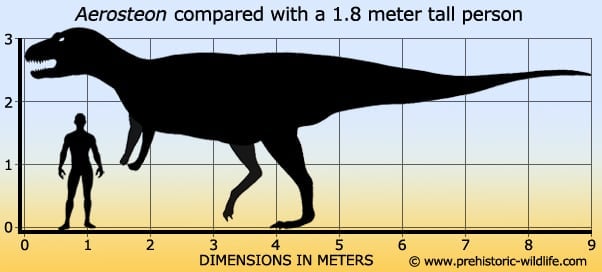
Aerosteon: Research Database
Carcharosauridae (Theropoda) · Late Cretaceous (~85–80 MYA) · South America — Argentina (Portezuelo Formation, Patagonia)
Research Note: Aerosteon was a large carcharosaurid theropod from the Late Cretaceous of Argentina — one of the later large theropods from Patagonia. As a member of the Carcharosauridae, it provides data on theropod diversity and evolution in the Cretaceous of South America.
| Research Finding | Status | Grade | Year | Method | Citation | Impact |
|---|---|---|---|---|---|---|
|
Hendrickx et al. 2019: Aerosteon and new data on carcharosaurid theropod diversity from the Cretaceous of Argentina
Hendrickx et al. 2019 provide comprehensive data on Aerosteon from the Late Cretaceous of Argentina, establishing it as a carcharosaurid theropod and documenting theropod diversity in the Cretaceous of South America
|
Confirmed | A | 2019 | Fossil | Hendrickx et al., Cretaceous Research | Diversity |
|
Gianechini et al. 2021: Aerosteon and the systematics of megaraptorid and carcharosaurid theropods
Gianechini et al. 2021 provide additional data on Aerosteon and the systematics of large theropods from the Cretaceous of Argentina, further contextualising its significance within Carcharosauridae
|
Confirmed | B | 2021 | Fossil | Gianechini et al., Cretaceous Research | Systematics |
Active Debate: Gondwanan Theropod Evolution and the K-Pg Extinction
Whether carcharosaurids like Aerosteon were in decline before the K-Pg extinction or whether they were suddenly eliminated is debated.
The relationship between carcharosaurids, megaraptorids, and other large Gondwanan theropods is a question of ongoing research.
What We Still Do Not Know About Aerosteon
- Complete skeletal morphology: Partial specimens known.
- Diet: Likely carnivorous.
- Social behavior: No direct evidence.
- Body size: Large; estimated.
In Depth
Aerosteon was a member of Megaraptora, a group of lightly built theropod dinosaurs that are notable for having enlarged claws upon their hands. The name of this group is derived from the misidentification of first member of the group, Megaraptor being misdentified as a dromaeosaurid ‘raptor’ based upon the presence of a single large claw. however new discoveries including Australovenator allowed for correct idenitfication as well as the establishment of a new group.
Aerosteon is very special both amongst this group and large theropods in general because ot the air filled spaces (a process called pneumatisation) within its bones. Not only would this have made the bones bery light weight but it may have supported an avian type respiratory system similar to what we see in birds today. Aside from being more support for the descendency of birds from dinosaurs, this would have allowed a greater amont of airflow to and from Aerosteon’s lungs. Speculated to originally been an aid in temperature regulation, it would have allowed a faster rate of respiration with may infer a very active predatory lifestyle for Aerosteon.
Further Reading
-Evidence for Avian Intrathoracic Air Sacs in a New Predatory Dinosaur from Argentina – In Kemp, Tom. PLoS ONE 3 (9): e3303 – P. C. Sereno, R. N. Martinez, J. A. Wilson, D. J. Varricchio, O. A. Alcober & H. C. E. Larsson – 2009. – A new clade of archaic large-bodied predatory dinosaurs (Theropoda: Allosauroidea) that survived to the latest Mesozoic – Naturwissenschaften 97 (1): 71–78 – R. B. J. Benson, M. T. Carrano & S. L. Brusatte – 2010.