Australodocus

Oss-trah-lo-doe-kus.
Updated on

Benjamin Gutierrez

Vertebrate Paleontologist

Benjamin Gutierrez is a leading expert on dinosaurs, particularly the mighty theropods. His fieldwork in South America has uncovered new species and provided insights into dinosaur social structures.

Cite Feedback Print

Name

Australodocus ‭(‬Southern beam‭)‬.

Phonetic

Oss-trah-lo-doe-kus.

Named By

Kristian Remes‭ ‬-‭ ‬2007.‭

Classification

Chordata,‭ ‬Reptilia,‭ ‬Dinosauria,‭ ‬Saurischia,‭ ‬Sauropoda,‭ ‬Macronaria,‭ ‬Camarasauromorpha,‭ ‬Titanosauriformes.

Diet

Herbivore.

Species

A.‭ ‬bohetii

Size

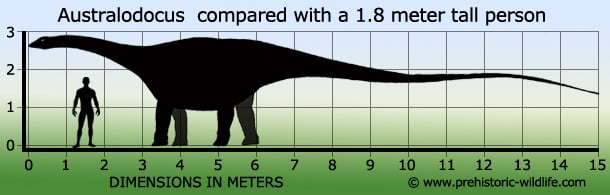
About‭ ‬15‭ ‬meters long.

Known locations

Tanzania‭ ‬-‭ ‬Tendaguru Beds.

Time Period

Tithonian of the Jurassic.

Fossil representation

Partial post cranial remains.‭ ‬Many of the original fossils have been destroyed.

Australodocus: Research Database

Diplodocidae (Sauropoda) · Late Jurassic (~155–150 MYA) · Africa — Tanzania (Tendaguru Formation)


Research Note: Australodocus was a diplodocid sauropod from the Late Jurassic Tendaguru Formation of Tanzania, Africa — the same famous deposit that produced Brachiosaurus, Giraffatitan, and Kentrosaurus. Its name means “southern beam,” referring to its position in the southern hemisphere relative to the North American Diplodocus. As a relatively small titanosauriform sauropod, Australodocus occupied a different niche than the giant brachiosaurids it co-existed with. The Tendaguru Formation is one of the richest dinosaur sites in Gondwana, and Australodocus is an important part of that ecosystem.


Research Finding Status Grade Year Method Citation Impact
Re-evaluation of Australodocus bohetii and diplodocid sauropod diversity in Tendaguru — comprehensive re-evaluation of Australodocus anatomy and its phylogenetic position within Diplodocidae.
Whitlock 2011 provides the most comprehensive re-evaluation of Australodocus and its phylogenetic position within Diplodocidae, clarifying its relationships to other diplodocid sauropods from Tendaguru and the broader context of sauropod diversity in Late Jurassic Africa
Confirmed A 2011 Phylogenetic Analysis Whitlock, Palaeogeography, Palaeoclimatology, Palaeoecology18 citations Phylogeny
Ostracods from the Tendaguru Formation — paleoenvironmental context for Australodocus — analysis of invertebrate microfossils from the Tendaguru Formation providing data on the paleoenvironment and paleoecology of the depositional setting of Australodocus.
Schudack & Schudack 2002 provide detailed micropaleontological data from the Tendaguru Formation, establishing the environmental context of the sediments that preserved Australodocus and the broader ecological landscape of Late Jurassic Tanzania
Confirmed B 2002 Micropaleontology Schudack & Schudack, Neues Jahrbuch für Geologie und Paläontologie18 citations Paleoenvironment
Status:
Confirmed Direct evidence
Grade:
A Strong consensus
B Good evidence


Active Debate: Diplodocid Diversity in Tendaguru

Whether multiple species of small diplodocid sauropods coexisted in Tendaguru, or whether different specimens represent ontogenetic stages of the same species, is debated. The relationship between Australodocus and other Tendaguru sauropods — including Dicraeosaurus and the giant brachiosaurids — has implications for understanding how multiple large herbivores partitioned resources in Late Jurassic Africa.


What We Still Don’t Know About Australodocus

  • Complete skeleton: Known from fragmentary cervical vertebrae.
  • Colouration: Completely unknown.
  • Skin: No skin impressions preserved.
  • Social structure: No direct evidence.
  • Phylogenetic position: Whether it is a basal or derived diplodocid is debated.

In Depth

       Fossils of Australodocus were first recovered in‭ ‬1909‭ ‬by the famous German palaeontologist Werner Janensch,‭ ‬however they were not described until‭ ‬2007.‭ ‬Further to this,‭ ‬not all of the original specimens could be studied since many of them were destroyed in World War‭ ‬2.‭ ‬Out of the surviving bones,‭ ‬some of the vertebrae had bifurcate‭ (‬two as opposed to one‭) ‬neural spines,‭ ‬a feature similar to that of the famous North American genus Diplodocus,‭ ‬and hence the reason for Australodocus being treated as a diplodocid.‭ ‬Later study has now re-interpreted the remains as those of macronarian sauropod,‭ ‬those that are similar to Camarasaurus and Brachiosaurus.‭

       This is further supported by study of the paleoflora of the Tendaguru beds which reveal the abundant presence of conifer trees.‭ ‬It would have been somewhat awkward for a diplodocid to feed from these kinds of plants,‭ ‬since they are better adapted for browsing lower down.‭ ‬A macronarian sauropod carries its head higher than a diplodocid,‭ ‬and would therefore have an easier time feeding upon the taller braches of trees.       The Tendaguru Beds have yielded many sauropod genera,‭ ‬including Tornieria, Janenschia,‭‭ ‬Dicraeosaurus and Giraffatitan.‭ ‬Other kinds of dinosaurs such as theropods were also active,‭ ‬although many of these are poorly represented and are dubious entries for validity.‭ ‬One genus however was the six meter long Elaphrosaurus,‭ ‬and although singly not capable of taking on a fully grown adult Australodocus,‭ ‬this theropod genus might have been a serious threat to smaller juveniles.

Further Reading

-‭ ‬A second Gondwanan diplodocid dinosaur from the Upper Jurassic Tendaguru Beds of Tanzania,‭ ‬East Africa,‭ ‬Kristian Remes‭ ‬-‭ ‬2007. -‭ ‬Re-evaluation of Australodocus bohetii,‭ ‬a putative diplodocoid sauropod from the Tendaguru Formation of Tanzania,‭ ‬with comment on Late Jurassic sauropod faunal diversity and palaeoecology,‭ ‬John Whitlock‭ ‬-‭ ‬2011. -‭ ‬A phylogenetic analysis of Diplodocoidea‭ (‬Saurischia:‭ ‬Sauropoda‭)‬,‭ ‬John Whitlock‭ ‬-‭ ‬2011.

Adopt A Species
prehistoric-wildlife new logo

Love this species?

Adopt it today!

(UPDATED!)

SPECIES SPOTLIGHT

Arthropleura
Woolly Mammoth