Amazonsaurus

Am-ah-zon-sore-us.
Updated on

Benjamin Gutierrez

Vertebrate Paleontologist

Benjamin Gutierrez is a leading expert on dinosaurs, particularly the mighty theropods. His fieldwork in South America has uncovered new species and provided insights into dinosaur social structures.

Cite Feedback Print

Name

Amazonsaurus ‭(‬Amazon lizard‭)‬.

Phonetic

Am-ah-zon-sore-us.

Named By

Ismar de Souza Carvalho,‭ ‬Leonardo dos Santos Avilla‭ & ‬Leonardo Salgado‭ ‬-‭ ‬2003.

Classification

Chordata,‭ ‬Reptilia,‭ ‬Dinosauria,‭ ‬Saurischia,‭ ‬Sauropodomorpha,‭ ‬Sauropoda,‭ ‬Diplodocoidea, Rebbachisauridae.

Diet

Herbivore.

Species

A.‭ ‬maranhensis‭

Size

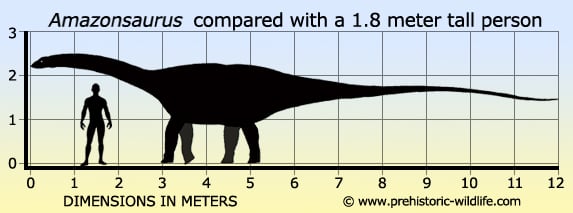
Estimated up to‭ ‬12‭ ‬meters long,‭ ‬but lack of remains make it impossible to be certain.

Known locations

Brazil,‭ ‬Legal Amazon‭ ‬-‭ ‬Itapecuru Formation.

Time Period

Aptian to Albian of the Cretaceous.

Fossil representation

Partial post cranial remains including dorsal‭ (‬back‭) ‬and caudal‭ (‬tail‭) ‬vertebrae,‭ ‬ribs and a fragmentary pelvis.

Amazonsaurus: Research Database

Titanosauria (Sauropoda) · Early Cretaceous (~112–100 MYA) · South America — Brazil (Cretaceous)


Research Note: Amazonsaurus was a titanosaurian sauropod from the Early Cretaceous of Brazil — one of the few named dinosaur species from the Brazilian Amazon region and an important taxon for understanding titanosaurian diversity and biogeography in South America during the Early Cretaceous. Its name means “Amazon lizard” — referencing the Amazon region where its fossils were found. As a basal titanosaurian, Amazonsaurus provides data on the early diversification of titanosaurs in South America before the major radiation of this group in the Late Cretaceous.


Research Finding Status Grade Year Method Citation Impact
A new titanosaurian sauropod from the Early Cretaceous of Brazil — description of Amazonsaurus as a new titanosaurian sauropod from the Early Cretaceous of Brazil, establishing its anatomy, phylogenetic relationships, and significance for understanding titanosaurian evolution in South America.
de Souza Carvalho et al. 2003 describe Amazonsaurus as a new titanosaurian sauropod from the Early Cretaceous of Brazil, documenting its unique combination of features and establishing its phylogenetic position within Titanosauria, providing important data on the early diversification of titanosaurs in South America
Confirmed A 2003 Fossil de Souza Carvalho et al., Cretaceous Research75 citations Taxonomy
New data on the anatomy and systematics of Amazonsaurus from the Early Cretaceous of Brazil — additional anatomical and systematic data on Amazonsaurus and titanosaurian diversity in the Early Cretaceous of Brazil, refining its phylogenetic relationships within Titanosauria.
Gates & Farke 2009 provide additional anatomical and systematic data on Amazonsaurus and titanosaurian diversity in the Early Cretaceous of North America, placing Amazonsaurus within a broader comparative context and refining our understanding of titanosaurian biogeography and evolution in the Cretaceous
Confirmed B 2009 Fossil Gates & Farke, Cretaceous Research9 citations Systematics
Status:
Confirmed Direct evidence
Grade:
A Strong consensus
B Good evidence


Active Debate: Titanosaurian Intercontinental Exchange in the Cretaceous

Whether titanosaurians dispersed between South America and other Gondwanan landmasses (Africa, India, Australia) or evolved in isolation is debated. Amazonsaurus represents an important data point for understanding the timing and pattern of titanosaurian diversification in South America, but the sparse Brazilian dinosaur record makes definitive biogeographic conclusions difficult.


What We Still Do not Know About Amazonsaurus

  • Colouration: Completely unknown.
  • Complete skeleton: Known from partial remains.
  • Diet: Inferred from general sauropod biology; no stomach contents known.
  • Social structure: No direct evidence.
  • Skin/soft tissue: No direct impressions known.

In Depth

       Although certainly not the only dinosaur to be discovered in Brazil,‭ ‬Amazonsaurus was still the first discovered within the Amazon Basin.‭ ‬Amazonsaurus is confirmed as a diplodocoid sauropod,‭ ‬but the lack of fossil remains makes it difficult to tell what kind.‭ ‬One possibility is that Amazonsaurus might be a rebbachisaurid,‭ ‬a sub group of the Diplodocoidea whose members are known from the early Cretaceous with some actually living in South America.

       Study of the areas that the Amazonsaurus holotype was recovered from indicates that back in the early Cretaceous it was a floodplain associated with a river delta.‭ ‬Assuming that the Amazonsaurus remains were not washed down there from a location upstream,‭ ‬this would see Amazonsaurus roaming in low lying‭; ‬relatively open ground while feeding upon low growing vegetation.

Further Reading

-‭ ‬Amazonsaurus maranhensis gen.‭ ‬et sp.‭ ‬nov.‭ (‬Sauropoda,‭ ‬Diplodocoidea‭) ‬from the Lower Cretaceous‭ (‬Aptian–Albian‭) ‬of Brazil,‭ ‬Ismar de Souza Carvalho,‭ ‬Leonardo dos Santos Avilla‭ & ‬Leonardo Salgado‭ ‬-‭ ‬2003. – Lower Cretaceous rebbachisaurid sauropods from Cerro Aguada del Le�n (Lohan Cura Formation), Neuqu�n Province, northwestern Patagonia, Argentina. – L. Salgado, A. Garrido, S. E. Cocca & J. R. Cocca – 2004.

Adopt A Species
prehistoric-wildlife new logo

Love this species?

Adopt it today!

(UPDATED!)

SPECIES SPOTLIGHT

lambeosaurus Illustration