In Depth
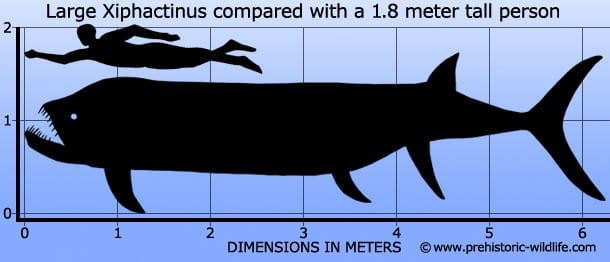
The broad range of fossils discovered around the world suggests that the bony fish Xiphactinus had a cosmopolitan distribution. A comparable similar fish with regards to appearance is the modern day Tarpon. Although Tarpon are not related to the ancient Xiphactinus, their streamlined bodies and strongly upturned mouths bear a striking resemblence.
One important difference between the two fish are the enlarged teeth present in Xiphactinus fossils. If Xiphactinus failed to swallow its prey in one go, the teeth would have dug in preventing its prey from escaping, allowing Xiphactinus to steadily slide its prey into its mouth, one bite at a time.
The discovery of a two meter Gillicus arcuatus inside the fossil of a Xiphactinus twice its size is proof that it was a formidable predator, although it is thought that the Xiphactinus may have died from internal injury due to the Gillicus struggling inside of it, explaining why the Gillicus was not digested. Xiphactinus was however also preyed upon by other larger predators as evidenced in a fossil of the shark Cretoxyrhina at least one specimen of which has been found with a large Xiphactinus inside of it. Another shark active in the Western Inland Seaway, Squalicorax, also exhibits Xiphactinus remains inside of its own.
Further Reading
– Notices of remains of extinct vertebrated animals of New Jersey, collected by Prof. Cook of the State Geological Survey under the direction of Dr. W. Kitchell. – Proceedings of the Academy of Natural Sciences of Philadelphia 8:220-221. – J. Leidy – 1856. – [Remarks on ichthyorudiolites and on certain fossil Mammalia]. – Proceedings of the Academy of Natural Sciences of Philadelphia 22(1):12-13 – J. Leidy – 1870 – Xiphactinus vetus and the Distribution of Xiphactinus Species in the Eastern United States. – Journal of Vertebrate Paleontology. 17 (3): 610–15. – D. R. Schwimmer, J. D. Stewart & G. Dent Williams – 1997.