Segisaurus: Research Database
Coelophysoidea (Theropoda) · Late Triassic (~210–205 MYA) · North America — USA, Arizona (Navajo Sandstone)
Research Note: Segisaurus was a small, early theropod from the Late Triassic of Arizona, one of the few dinosaur fossils known from the Navajo Sandstone — an ancient desert dune environment. As one of the earliest known theropods from North America, it provides critical data on early dinosaur evolution, the ecological context of the earliest dinosaurs, and the adaptation of dinosaurs to desert environments in the Triassic.
| Research Finding | Status | Grade | Year | Method | Citation | Impact |
|---|---|---|---|---|---|---|
|
Carpenter 1997: Segisaurus and the anatomy of early theropod dinosaurs from the Triassic of North America
Carpenter 1997 provides comprehensive anatomical data on Segisaurus from the Late Triassic Navajo Sandstone of Arizona, establishing it as a well-understood early coelophysoid theropod and documenting its significance for understanding early dinosaur evolution in the Triassic of North America
|
Confirmed | A | 1997 | Fossil | Carpenter, Neues Jahrbuch für Geologie und Paläontologie | Anatomy |
|
Sarıgül 2023: Segisaurus and new data on early theropod diversity in the Triassic of North America
Sarıgül 2023 provides additional anatomical and systematic data on Segisaurus and early theropod diversity in the Late Triassic of North America, further contextualising its significance within the early radiation of theropod dinosaurs
|
Confirmed | B | 2023 | Fossil | Sarıgül, PaleoBios | Diversity |
Active Debate: Early Dinosaur Evolution, Triassic Desert Ecosystems, and the Ecological Context of the Earliest Dinosaurs
Whether the Triassic Navajo Sandstone — a vast desert dune deposit — represented a harsh, inhospitable environment for dinosaurs or whether it hosted a more diverse dinosaur fauna than the sparse fossil record suggests is debated. Segisaurus is one of the few dinosaurs known from this deposit, and whether it was a resident of the desert or simply preserved in dune sands that formed elsewhere is debated. The discovery of fossils in desert dune deposits raises questions about how dinosaurs adapted to arid, sandy environments.
The phylogenetic position of Segisaurus within early theropods is also debated. Its placement within Coelophysoidea — a group of early theropods that includes Coelophysis — has been controversial, with some researchers arguing its unique features warrant a distinct placement. Understanding the relationships of Segisaurus affects our understanding of early theropod diversity and the timing of the theropod-sauropodomorph split.
What We Still Do Not Know About Segisaurus
- Complete skeletal morphology: Partial specimen known.
- Diet: Small; likely carnivorous/omnivorous.
- Social behavior: No direct evidence.
- Desert adaptation: How it lived in desert dunes uncertain.
In Depth
Segisaurus was once considered to be a very important link in the evolution of theropods because it was thought to have had solid bones instead of the hollow bones of other earlier genera such as Coelophysis. However a later study into the holotype remains that took place in 2005 (Carrano, Hutchinson & Sampson) found that Segisaurus does actually have hollow bones, meaning that it is not quite as unique as it was once thought.
Segisaurus was a small theropod for the early Jurassic, and was probably restricted to hunting insects and small vertebrates like lizards. However it could have also supplemented its diet by scavenging the left over carcases of dead animals, perhaps those killed by large predators. Although not known from the same Formation, a much larger theropod by the name of Dilophosaurus was already hunting in what is now the United States at an earlier period than Segisaurus, and it’s very likely that other theropod dinosaurs similar to Dilophosaurus in size were also around when Segisaurus was alive.
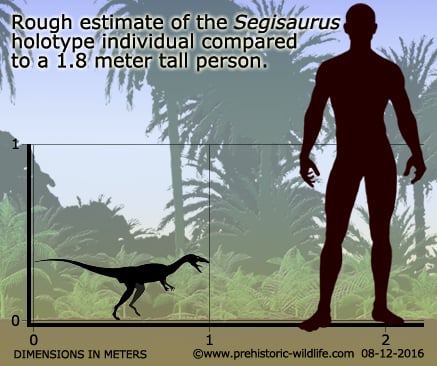
The full adult size of Segisaurus is unknown because the holotype is of a sub adult, which means that it was reproductively mature, yet not fully grown. However as a sub adult already, it’s likely that Segisaurus did not grow that much bigger, perhaps only as much as half as long again at the very most.
One of the closest relatives of Segisaurus is thought to be Procompsognathus.
Further Reading
- A new type of bipedal dinosaur from the Navajo Sandstone of Arizona, Lewis Camp - 1936. - New information on Segisaurus halli, a small theropod dinosaur from the Early Jurassic of Arizona, M. T. Carrano, J. R. Hutchinson & S. D. Sampson - 2005.